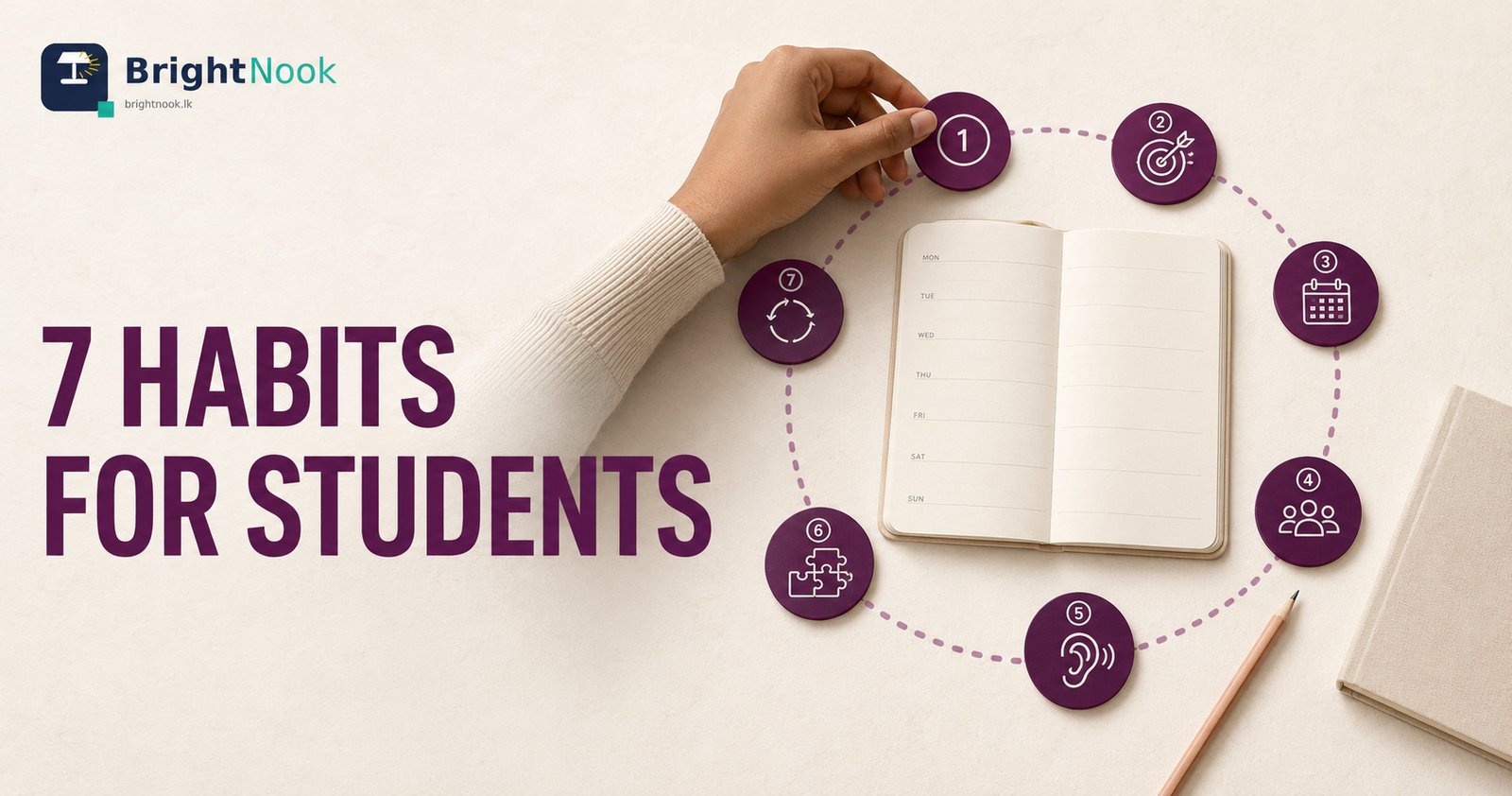
Studying well isn't just a matter of putting in more hours. It comes down to taking ownership, knowing where you're headed, guarding your most important work, and getting better at working with other people.
This guide takes the ideas Stephen R. Covey laid out in The 7 Habits of Highly Effective People and applies them to the everyday realities of being a student. It isn't meant to replace the book, and it doesn't walk through it chapter by chapter. The examples, exercises and seven-day challenge below were put together for students by BrightNook.
The seven habits, translated into things students actually do
| Principle from the book | What it looks like for students | A good first step |
|---|---|---|
| Be Proactive | Focus on your own response and whatever is actually within your control. | Swap one complaint for one practical next step. |
| Begin with the End in Mind | Decide what successful learning would actually look like before you start planning. | Write down one clear outcome for the term or course. |
| Put First Things First | Carve out protected time for the learning tasks that matter most. | Put the week's three most important tasks on the calendar first. |
| Think Win/Win | Aim for outcomes that are fair to everyone in group work and shared learning. | Sort out who's doing what before a group task even starts. |
| Seek First to Understand, Then to Be Understood | Listen carefully before jumping in to defend your answer or opinion. | Sum up the other person's point before you respond. |
| Synergize | Pull different strengths together to get a better result than any one person could alone. | Hand out group roles based on ability, not just who's friends with whom. |
| Sharpen the Saw | Keep renewing your capacity to learn through balanced care and growth. | Block off one period for sleep, movement, reflection or reading. |
Putting each habit into practice
1. Be proactive: focus on what's actually yours to influence
No student controls every teacher, every exam question, every family difficulty or every internet outage. What you can control is how early you start, whether you speak up when something's unclear, how you spend the next hour, and whether you actually learn from a mistake.
Being proactive doesn't mean pretending real obstacles aren't there. It means naming the obstacle honestly, then figuring out which part of your response is still up to you.
Student example: Instead of saying, “The lesson was confusing, so I can't study it,” pin down the exact point that's tripping you up and take it to a teacher, a classmate or a reliable textbook.
2. Begin with the end in mind: decide what kind of learner you want to be
A timetable only helps if it's actually pointing somewhere. Before you start filling hours with tasks, work out what you want to understand, finish or get better at.
A goal needs to be more specific than “study harder.” Something like: “By the end of this term, I want to be able to explain the core concepts without looking at my notes and finish past-paper questions in the time allowed.”
Grades matter, obviously, but they're not the only worthwhile destination. Your goal might also involve stronger communication, more reliable work habits, deeper understanding or getting ready for a particular career.
3. Put first things first: protect important work before it becomes urgent
Most students spend the day reacting to whatever deadline, message or notification is closest. Important work — revision, reading ahead, practising the hard questions — keeps getting pushed back simply because it isn't urgent yet.
A plan that actually works starts with your most important outcomes, not with every small task on your list. Pick a handful of priorities and give them a real slot in the week. Leave some slack too, because something unexpected always turns up.
Common mistake: Building a flawless-looking timetable that assumes endless energy and zero interruptions. A modest plan you stick to beats an impressive one you abandon.
4. Think win-win: make cooperation fair
Healthy cooperation isn't one student doing all the work while everyone else gets equal credit. It also isn't holding back useful knowledge because someone else might improve because of it.
A win-win approach looks for an arrangement that's fair to everyone: the group ends up with good work, responsibilities are out in the open, and each person gets a real chance to contribute and learn.
Student example: Before starting an assignment, agree on what the finished product should look like, who's responsible for what, when you'll check in, and what happens if someone can't finish their part.
5. Seek first to understand: listen before preparing your defence
Listening is itself a learning skill. When students get feedback, they often jump straight to explaining why the mistake happened instead of actually understanding what needs to change.
Before you respond, check that you've understood correctly. Try something like: “So if I've got this right, the formula's correct but the reasoning behind it isn't explained — is that the main problem?”
None of this means agreeing with every opinion you hear. It just means getting the message right before you put forward your own.
6. Synergize: use differences as resources
Students in the same group often think, communicate and solve problems in different ways. Those differences can be a source of frustration — but used deliberately, they can also lead to better work than any one person could produce alone.
One person might be great at organising the work, another at explaining concepts clearly, another at spotting calculation or language errors. Good teamwork combines those strengths rather than expecting everyone to operate the same way.
Common mistake: Splitting the assignment into isolated chunks and stitching them together at the last minute. Cooperation gets better when the group also takes time to check how those pieces fit.
7. Sharpen the saw: renew your capacity to learn
Studying nonstop without any renewal tends to wear down concentration, until even simple work starts to feel hard. Balanced renewal covers looking after your body, continuing to learn, keeping up supportive relationships, and leaving room for reflection or spiritual life, however that fits your values.
This isn't a licence to dodge hard work. Renewal is what lets you come back to that work with sharper attention and more steadiness.
Student example: A short walk, enough sleep, some quiet reflection or a conversation with someone supportive can do more for tomorrow's studying than one more exhausted hour tonight.
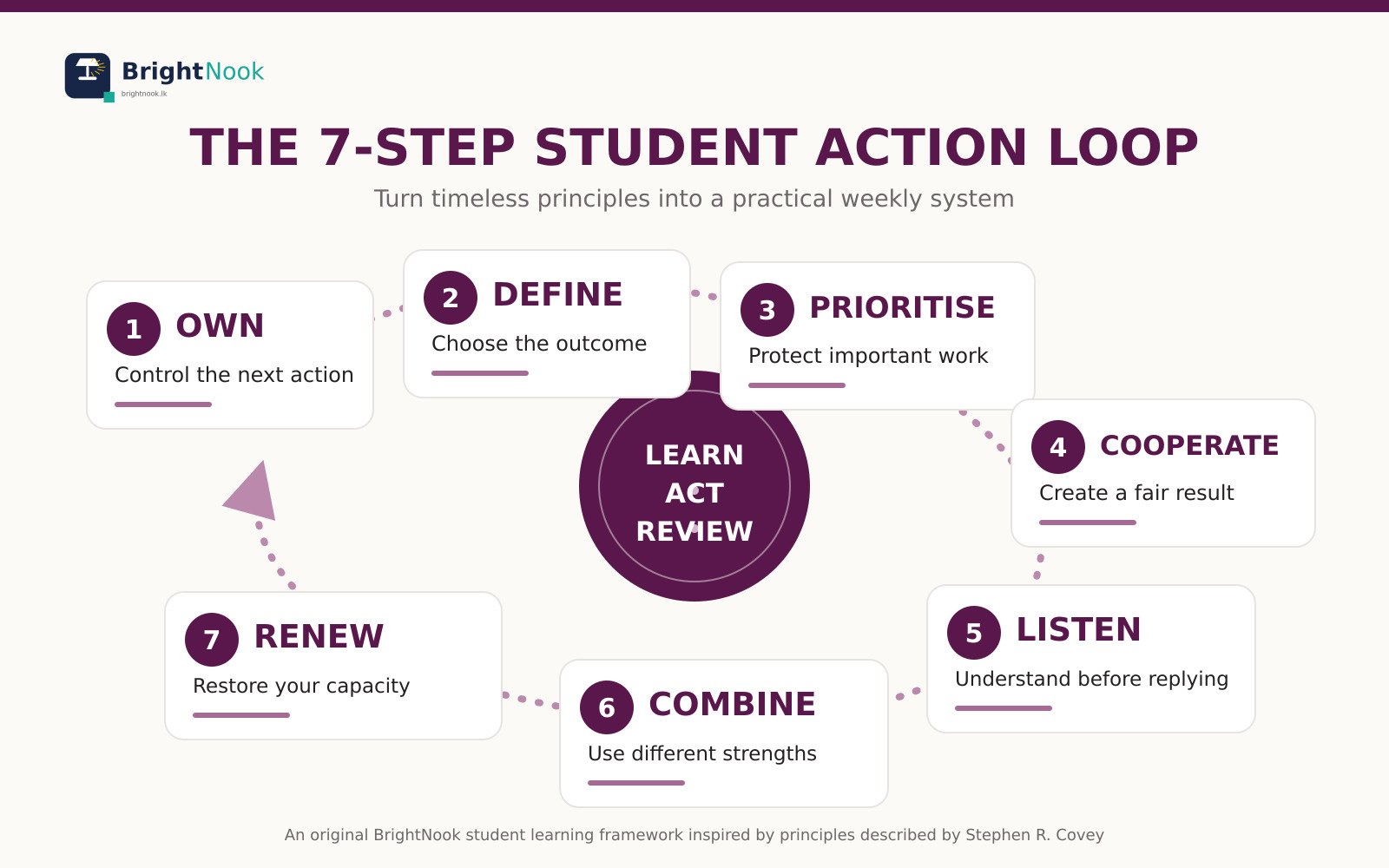
A simple weekly system built on the seven habits
- Choose your direction: Write down the single most important learning outcome for the week.
- Check your influence: Work out what you can personally do to move toward it.
- Select three priorities: Choose the tasks that would make the biggest difference.
- Schedule important work: Give those tasks specific time slots before the week fills up.
- Coordinate with others: Get expectations clear for any shared work.
- Listen and adjust: Use feedback to improve the plan instead of defending it.
- Include renewal: Protect enough rest, movement, learning and reflection to keep going.
- Review: At the end of the week, jot down what worked, what didn't and one change to make next week.
A seven-day student habit challenge
- Day 1 - Responsibility: Turn one complaint you keep repeating into a practical next step.
- Day 2 - Direction: Write down one meaningful outcome for your current term, course or exam.
- Day 3 - Priorities: Finish one important task before you open entertainment or social media.
- Day 4 - Mutual benefit: Nail down a fair share of responsibility in a group task.
- Day 5 - Listening: Ask someone a question and just listen, without rehearsing your reply while they talk.
- Day 6 - Cooperation: Ask someone with a different strength to review or improve your work.
- Day 7 - Renewal: Look back on the week and plan one activity each for physical, mental, social and reflective renewal.
Student self-assessment
Use these as a private check-in, not a score of your worth or ability.
- When something goes wrong, can I name one action that's actually within my control?
- Do I actually know what I want to understand or achieve this term?
- Do important tasks get time before they turn into emergencies?
- Are responsibilities clear and fair when I'm working with others?
- Can I take in feedback without immediately jumping to defend myself?
- Do I put other people's different strengths to good use?
- Does my week leave room for enough renewal to keep learning sustainably?
Pick just one weak spot to work on first. Trying to overhaul every habit at once just turns personal growth into another unrealistic to-do list.
Frequently asked questions
Is this a complete summary of The 7 Habits of Highly Effective People?
No. This is an independent guide to applying the framework as a student — it doesn't reproduce the book's full arguments, stories, diagrams or exercises.
Should I practise all seven habits at once?
It helps to understand them as a connected system, but start with one behaviour that would make a real difference, then review it weekly before adding another.
Which habit is most useful before an examination?
Starting with a clear outcome and putting important work first tends to improve exam prep, while renewal helps protect your capacity to keep going. Proactivity matters most when your plans get interrupted.
Will these habits guarantee better grades?
No habit system can guarantee a particular outcome. Academic performance also depends on prior knowledge, teaching, health, resources, assessment conditions and plenty of other circumstances. What these habits offer is a way to improve the quality of your own decisions and actions.
Can school students and university students both use this guide?
Yes. The scale of the decisions changes, but responsibility, direction, priorities, listening, cooperation and renewal matter at every stage of education.
For Sri Lankan readers
සිංහල සාරාංශය: සිසුන්ට තමන් පාලනය කළ හැකි දේ කෙරෙහි අවධානය යොමු කර, පැහැදිලි ඉලක්ක තබා, වැදගත් කාර්යයන්ට ප්රමුඛත්වය දීම මෙම මාර්ගෝපදේශයේ මූලික අදහසයි. හොඳ සන්නිවේදනය, කණ්ඩායම් වැඩ සහ ශාරීරික හා මානසික අලුත් වීමත් ඉගෙනීමේ සැලැස්මේ කොටසක් කරගන්න.
தமிழ் சுருக்கம்: மாணவர்கள் தங்களால் கட்டுப்படுத்தக்கூடிய செயல்களில் கவனம் செலுத்தி, இலக்கைத் தெளிவுபடுத்தி, முக்கிய பணிகளுக்கு முன்னுரிமை கொடுக்க வேண்டும். நல்ல தொடர்பு, குழுப் பணி, உடல் மற்றும் மனப் புத்துணர்வு ஆகியவற்றையும் படிப்புத் திட்டத்தின் ஒரு பகுதியாகக் கருதுங்கள்.
Source
Covey, Stephen R. The 7 Habits of Highly Effective People: Powerful Lessons in Personal Change, 25th Anniversary Edition. The names of the seven habits come directly from the author's original framework.